
APTRINDO Affirms: The Transition to Electrical Energy Efficiency in the Logistics Sector is a New Hope and a Major Challenge for Indonesia’s Policy Direction
The energy transition in Indonesia’s logistics sector, particularly electric trucks, offers significant savings and national efficiencies. This highlights the opportunities, regulatory challenges, and future policy directions of the government.

APTRINDO Chairman Gemilang Tarigan: “The number of trucks in Indonesia has reached around 6.4 million units. However, only about 21 percent are under 5 years old.”
Amid increasingly rapid and uncertain global dynamics, Indonesia’s energy and logistics sectors are facing significant pressure. Fluctuating energy prices, supply chain disruptions, and demands for emission reductions are pushing the government to accelerate the energy transition, including in the transportation sector.
One emerging focus is the electrification of logistics vehicles, particularly trucks. This sector is considered to have significant potential to reduce fuel consumption while increasing national economic efficiency. Despite the focus on electric vehicles, the trucking sector presents both significant challenges and significant opportunities.
In terms of energy consumption, trucks are the most wasteful fuel users:
- Motorcycle: 1:40–1:50
- Private car: 1:10–1:15
- Logistics truck: about 1:2.5
With millions of units in operation, the contribution of trucks to national fuel consumption is very significant.
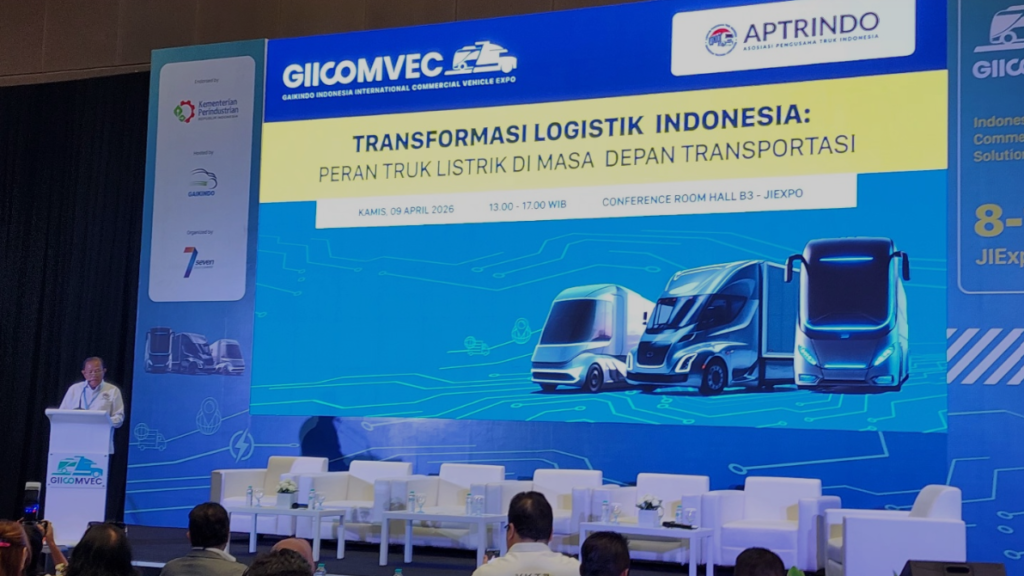
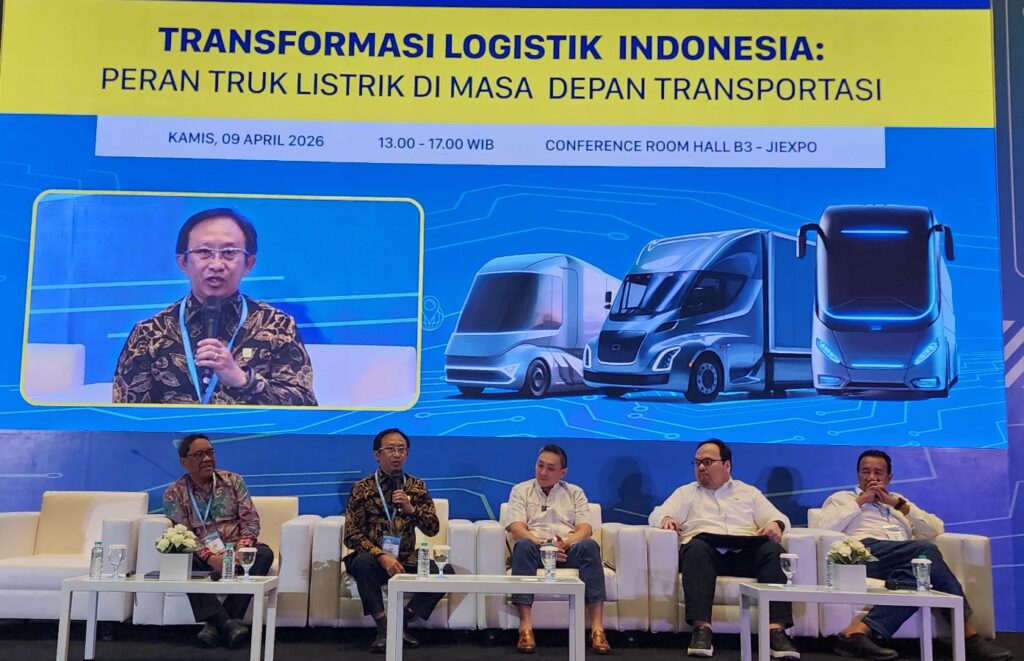
Chairman of the Indonesian Truck Entrepreneurs Association (APTRINDO) Gemilang Tarigan at a seminar entitled “Transformation of Indonesian Logistics: The Role of Electric Trucks in the Future of Transportation” at Hall B JIExpo Kemayoran Jakarta (Thursday, April 9, 2026), said that the current condition of the national truck fleet is also a challenge in itself.
“The number of trucks in Indonesia has reached around 6.4 million units. However, only about 21 percent are under 5 years old. In fact, around 65 percent are over 20 years old,” said Gemilang Tarigan at a seminar titled “Transformasi Logistik Indonesia.”
He added that only a small percentage of trucks meet operational standards, including in strategic areas like ports. This situation reinforces the urgency of fleet renewal and the transition to more efficient and environmentally friendly vehicles.
As of February 2026, the government recorded the construction of thousands of Public Electric Vehicle Charging Stations (SPKLU) in various regions of Indonesia.
The Ministry of Energy and Mineral Resources (ESDM) conveyed a similar sentiment, continuing to push for a national energy transformation toward independence and sustainability. The Minister of Energy and Mineral Resources, delivered by his representative, stated that structural changes in the transportation sector are ongoing.
“Dependence on fossil fuels is being reduced, the use of biofuels is being encouraged, and the adoption of electric vehicles is being accelerated. The government is also developing the ecosystem, from the battery industry and charging infrastructure to supporting services,” said Ahmad Amirudin, Director of Electricity Development at the Ministry of Energy and Mineral Resources.
As of February 2026, the government has recorded the construction of thousands of Public Electric Vehicle Charging Stations (SPKLU) across Indonesia, which will continue to be expanded to increase public and business confidence.
Big Opportunities: Efficiency and Environmental Impact
Truck electrification is considered to be a strategic solution to these various problems.
In addition to reducing carbon emissions, electric trucks also offer the following advantages:
- Lower operating costs compared to fuel
- Simpler maintenance
- More stable energy prices
If implemented widely, electrification of this sector has the potential to provide significant savings on national energy consumption and reduce the burden of government subsidies.
Real Challenges : Regulation to Infrastructure
Despite its huge potential, the implementation of electric trucks in Indonesia still faces various obstacles.
One of the most crucial issues is the lack of synchronization of regulations in the field. Businesses believe that various technical and operational regulations do not fully support the characteristics of electric vehicles.
“The problem isn’t just technology. Small regulatory issues often become the main operational bottlenecks,” Gemilang said.
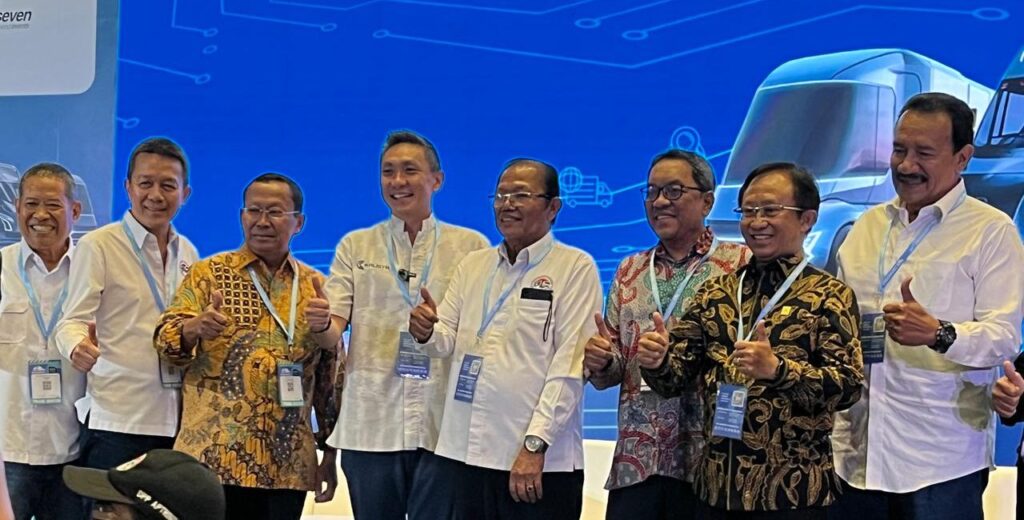
With synergy between the government and businesses, along with appropriate policy support, electric trucks have the potential to become the new backbone of a more efficient and sustainable national logistics system.
Additionally, other challenges include:
- Uneven charging infrastructure
- The initial investment requirement is still high
- Technical standards for electric vehicles are not yet uniform
This condition makes business actors still cautious in carrying out mass adoption.
Energy Subsidies: Need a New Direction
Amid efforts to accelerate the development of electric vehicles, there is a growing push for more targeted energy subsidy policies.
So far, electric vehicle incentives have been primarily directed at two-wheeled vehicles. However, in terms of energy consumption, the logistics sector has a far greater impact.
Business actors have proposed that some fuel subsidies be gradually diverted to support electric vehicles, including trucks.
“If subsidies were diverted, the government’s savings could be greater, the energy transition could be faster, and the environmental impact would be more pronounced,” Gemilang said.
However, he stressed that the policy must be carefully designed to maintain balance and not cause social impacts.
Transformation is Not Just About Technology
The transition to electric trucks also demands a complete change in the logistics ecosystem.
In addition to the vehicle, it is necessary:
- New business models, such as battery schemes
- Retraining of drivers and technicians
- Digital system integration for operational efficiency
Digitalization, for example, can reduce empty truck trips, which have long been a source of inefficiency in the supply chain.
Optimism with Notes
Despite the challenges, business players continue to express their support for the development of electric trucks in Indonesia. The industry has even begun to demonstrate concrete steps, including the development of domestic production facilities.
However, they stressed that the success of this transition depends heavily on:
- Regulatory certainty
- Clarity of direction of subsidy policy
- Acceleration of infrastructure development
Without it, the sector’s enormous potential is feared to be difficult to fully realize. Electric trucks offer a strategic opportunity for Indonesia to improve energy efficiency and accelerate the transition to a low-carbon economy.
However, the challenges faced extend beyond technology to regulations, infrastructure, and fiscal policy. With synergy between the government and businesses, along with appropriate policy support, electric trucks have the potential to become the new backbone of a more efficient and sustainable national logistics system.